The Dark Corner Did Not Need More Decor. It Needed a Second Light Source.

Mina ChoiPortland, United States
Rental-friendly small-space creator and design studio coordinator
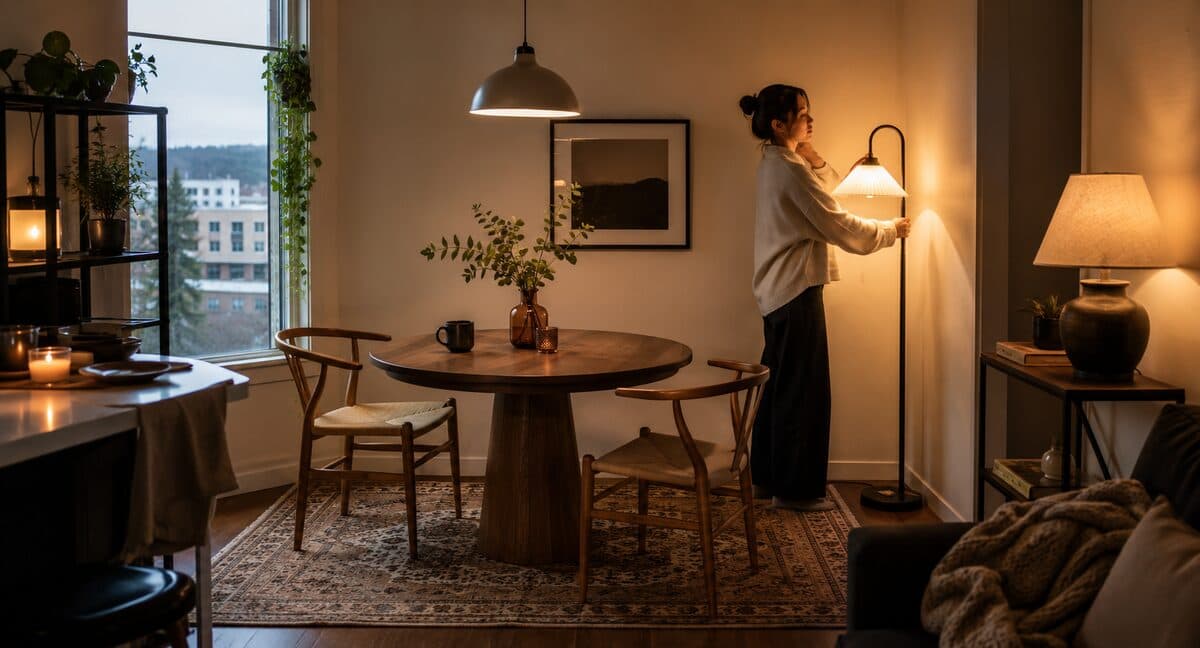
Every apartment has one corner that teaches you what the room is actually missing.
Mine was a dining nook that looked depressing no matter what I put on the table. I tried the usual things first because that is what everyone tries first. A bowl. A stack of books. A candle. Then a tray, because apparently all design confusion can be hidden under a tray for about three days. None of it fixed the problem. The problem was not styling. The problem was that the entire corner was lit by one overhead fixture trying and failing to do the job of three lights.
That is the kind of thing my content lives on.
I do not make renovation content for homeowners with contractors and mood boards. I make content for renters who have one dim ceiling light, beige carpet, a landlord who answers slowly, and a very specific fear of losing the security deposit over something as stupid as a wall anchor. When a video works on my account, it is usually because I name the real constraint. Not "small-space dining makeover." More like: your apartment does not feel cozy because the lighting is flat, your rug is too small, and everything important is happening at the same height.
People respond because they are tired of being told that all a room needs is better taste.
Most rooms need better information.
So my posts got more useful. I started breaking them into parts people could actually copy: where the second lamp goes, how far the rug should sit under the table, what kind of peel-and-stick sconce is worth buying, how to test bulb temperature without making your living room feel like a dental office, what to use when your lease says no holes, and which "renter-friendly" products are only renter-friendly if your definition of friendly includes scraping adhesive off paint for an hour.
The comments became incredibly specific, which I like. "Can you link the floor lamp?" "What bulb warmth did you use?" "Do you have the shelf dimensions?" "Would this work in a studio?" "Can you send the layout?" The problem was not that people wanted too much. The problem was that useful home content creates a lot of little requests, and those requests show up while I am doing exactly the kind of real-life work that made me good at this in the first place.
My day job is coordinating projects at a design studio. Which means that when a Reel about renter-friendly lighting starts moving, I am often in the middle of site notes, vendor emails, material approvals, or a conversation about why a sample that looked warm beige in one room suddenly looks like damp cardboard in another. I cannot stop every forty minutes to paste the same lamp links and layout notes into my DMs. By the time I get back to my phone, the energy that made someone want to fix their dining corner that night has usually faded into saved-post limbo.
That is the exact kind of friction I use StarLovin for.
If someone comments LIGHT, they get my renter-friendly lighting list in DMs. LAYOUT sends the small dining area setup guide. SHELF sends the dimensions and install notes for the wall shelf people keep asking about. That is the entire point. Not to make the account feel more automated. To make the next step easier while someone is still standing in their apartment looking at the problem.
Because that is when room decisions actually happen. Not on a Saturday two weeks later when they remember there was "some creator" who posted "something about lamps."
There is one thing I do ask people to leave an email for: the fuller room makeover planner. That one is bigger than a shopping list. It includes budget breakdowns, measuring notes, layered lighting logic, and a step order that keeps people from buying decor before they have solved function. It makes more sense as something I can follow up on later, especially when I post updated budget ranges or new versions of the same layout for studios, bedrooms, or awkward entryways. So StarLovin collects the email in the DM before sending it and saves the contact. That way the people who wanted the deeper plan are not lost the moment Instagram moves on.
But the reason people trust me is that I do not pretend every room problem can be solved by a checklist.
If someone messages me and says, "My landlord will not allow adhesive, my dining area is also my work area, and I only have two outlets, one of which already powers the router," I still want to answer that myself. If someone has a toddler who can pull a lamp over, or a studio where every furniture move affects the bed, the desk, and the only walk path to the kitchen, that is not a simple download situation. That is design judgment. That is exactly the line where automation should stop and a real person should step in.
That is why I care about keeping those conversations in one place. Social Inbox lets me see what someone originally asked for, pause the automation if needed, and reply without losing the thread. Which matters, because design advice gets irresponsible fast when it forgets that people live in the rooms, not just photograph them.
I think that is what separates useful renter content from decorative content.
The decorative version says: here is a pretty corner.
The useful version says: here is why your corner feels bad, here is the first thing to fix, here is the link if you need it, and here is where a human still has to look at your actual space.
Most small rooms do not need more stuff.
They need one good decision made in time.
The Hard Part Was Never Making the Earrings. It Was Catching People Before the Drop Closed.
Next articleThe Follow-Up Email Was Never the Hard Part. Knowing Which One to Send Was.
Keep Reading

The Hard Part Was Never Making the Earrings. It Was Catching People Before the Drop Closed.
Keep reading
The Follow-Up Email Was Never the Hard Part. Knowing Which One to Send Was.
Keep reading