A Morning Chart Has One Job: Get Everyone to Shoes

Sarah CollinsDenver, United States
Former first-grade teacher and family routine creator
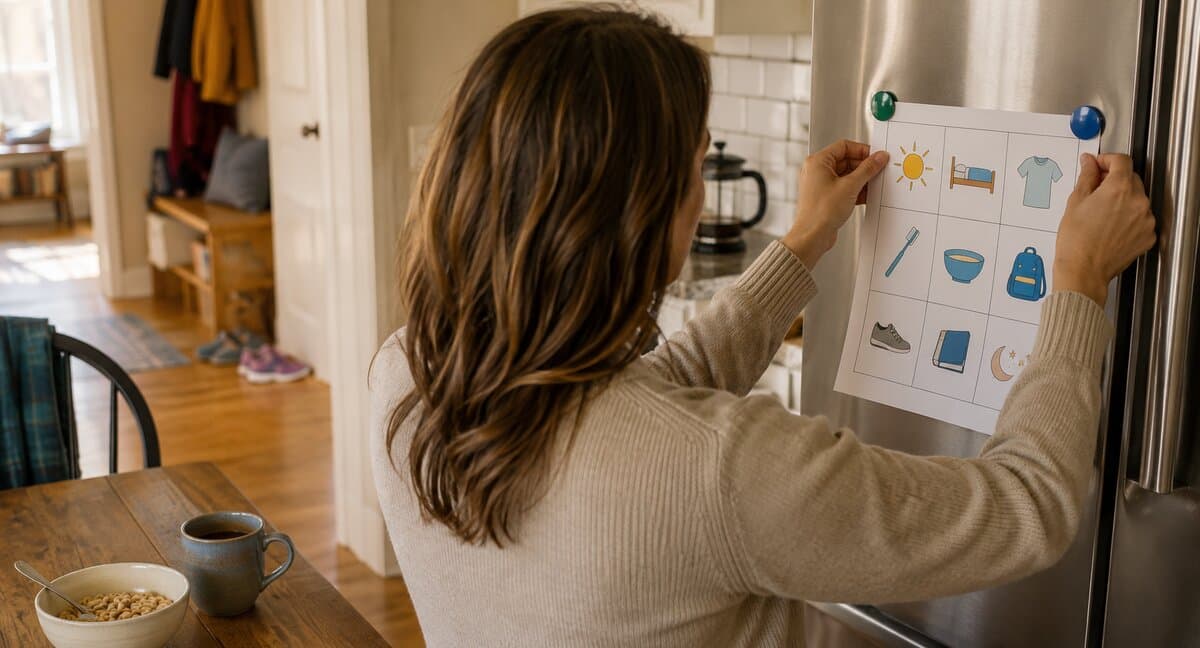
The internet loves a cute morning routine chart. Pastel boxes. Tiny icons. Matching fonts. A child in linen pajamas pointing at "brush teeth" like they are leading a board meeting.
I taught first grade for twelve years. I have bad news.
Cute is not a system.
A chart works when a child can use it without an adult narrating every step like a flight attendant. That means pictures big enough to understand from across the kitchen. Five steps, maybe six if everyone slept well. A clip, magnet, velcro square, anything the kid can physically move. Children believe what their hands do.
That is the classroom part of my brain talking.
The parent part of my brain is usually looking for the missing shoe.
The Reel that got shared around was not special. My preschooler had dumped Cheerios on the floor before 7:15. My older kid was angry about sleeves. I had reheated my coffee once already, which in my house counts as optimism.
The chart was on the fridge. Potty. Clothes. Breakfast. Teeth. Shoes.
My kid moved the little marker after each step, and for one blessed morning, I did not say "go get your shoes" eleven times. I said it maybe three times. Progress.
Parents understood the assignment immediately. Over the next two days my DMs filled up, and I started noticing a pattern in who was reaching out and when.
The 6am crowd were the ones still in bed, scrolling before the baby woke up, looking at my chart and thinking maybe today. They needed the file before their feet hit the floor or the moment would pass. The lunch-break crowd were at work, still carrying the memory of that morning's shoe meltdown, searching for anything that might make tomorrow different. And the 10pm crowd — those were my people. Phone in one hand, cold tea in the other, finally sitting down for the first time since 5pm. They had been thinking about my chart all day but could not find thirty seconds to type "send me that thing" until the house was quiet.
None of them asked for a parenting philosophy. They wanted the printable. Some had a toddler and needed a version with no words at all — their kid was two and sharp but not reading yet. Some were already using a chart that was twelve steps long and felt like a second job, and they wanted something shorter, something that felt possible. A few asked if I had a bedtime version, because mornings were actually fine in their house but evenings were a slow descent into everyone crying.
It was not complicated what they needed. It was just hard to deliver while I was in the middle of my own chaos.
I used to send the file after bedtime.
This sounds reasonable unless you have lived inside bedtime. Bedtime is when I become a person made of crumbs and unfinished thoughts. I would open Instagram, see a stack of messages, paste the same chart link until my eyes blurred, and then wake up the next morning to more.
Nobody was being demanding. Parents were just catching the post in the one minute they still believed tomorrow could be smoother.
I wanted the chart to reach them during that minute.
So I set up CHART in StarLovin. Comment the word, get the printable. LUNCH sends my lunch-packing cheat sheet. I do not use a complicated flow because nobody needs complexity at 6:43am. They need the paper.
There is one longer thing, the toy rotation planner, that I send by email because it needs explanation. Toy rotation is not "hide half the toys and hope." It is age, categories, storage, what stays out, what comes back later, and what to do when a child suddenly decides every toy is offensive. That one needs a few follow-up notes or it becomes another PDF sitting in Downloads.
Everything else should be frictionless.
I am careful with parenting content because advice gets smug fast.
A chart may help a morning. It will not fix a sleep regression, sensory sensitivity, a new baby in the house, or a kid who has decided socks are a personal attack.
The messages that stay with me are the ones a keyword cannot touch. A mom wrote me last month: her five-year-old refused to even look at the chart. Not angry, just indifferent. She had tried stickers, timers, turning it into a game, and nothing moved the needle. I wrote back that sometimes the problem is not the chart — sometimes the kid is overwhelmed by something else entirely, and the chart just becomes the visible thing they push against. We went back and forth a few times, and eventually she realized the issue started when their new baby arrived and the morning routine had quietly shifted from "us time" to "hurry up, the baby needs me." That is not a printable problem. That is a person noticing something another person needed to say out loud.
I still answer those myself, usually late at night, because twelve years of teaching taught me the difference between a handout and a conversation. StarLovin can deliver the chart. It cannot tell a tired mother that her kid is not broken and neither is she.
That is why I still like making these small things. They do not promise a new life. They just remove one tiny fight from the day.
And some mornings, one tiny fight is the difference between leaving on time and crying in the car because someone wanted the blue cup.
Your First $19 Digital Product Is Not Going to Change Your Life
Next articleI Pre-Walked 37 Trails So You Stop Asking If They're Beginner-Friendly
Keep Reading

The Hard Part Was Never Making the Earrings. It Was Catching People Before the Drop Closed.
Keep reading
The Dark Corner Did Not Need More Decor. It Needed a Second Light Source.
Keep reading