I Tracked Every DM for 30 Days. The Problem Was Not Response Time.

Ethan BlakeBoston, United States
Notion workflow template creator and former product operations lead
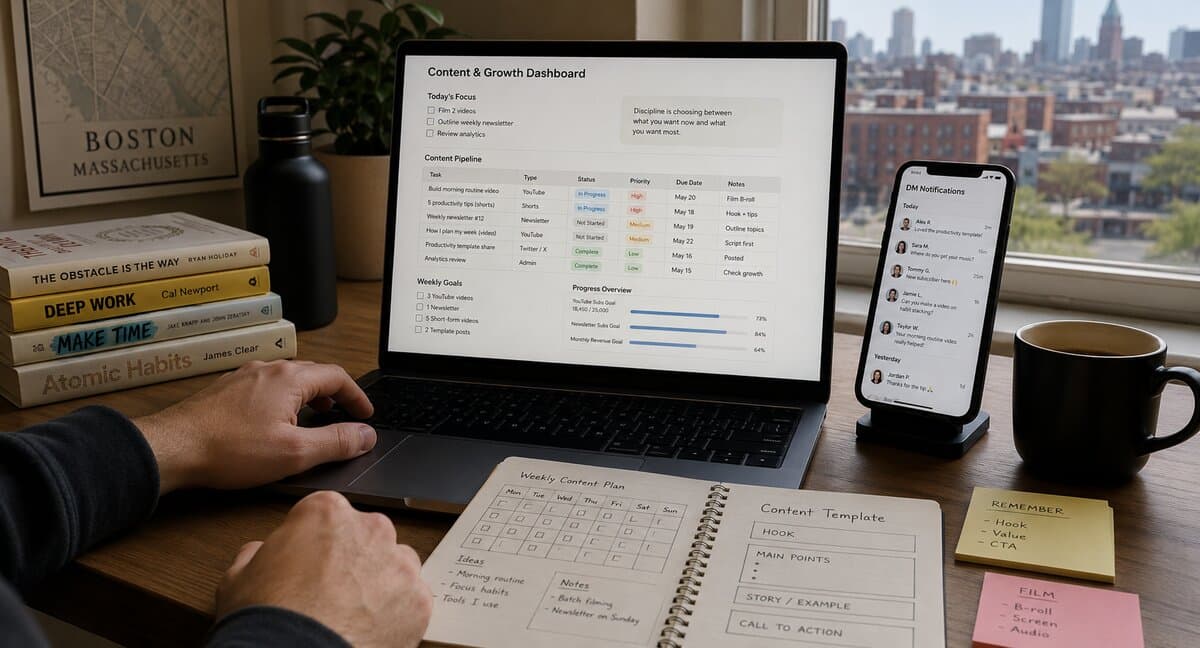
I made a spreadsheet because I was annoyed.
Column A: date.
Column B: source post.
Column C: what they asked for.
Column D: when I replied.
Column E: did they click after I sent the link.
No dashboard. No color scale. No dramatic productivity theater. Just a month of Instagram DMs turned into rows because I wanted to know whether my feeling was correct.
It was not.
I thought I had a response-time problem. I had a distribution problem.
In thirty days, I got forty-seven DMs. Forty-one were requests for four files:
27 — Creator Content Calendar
8 — Client Follow-Up Tracker
4 — Tool Comparison Sheet
2 — Weekly Workflow Audit
Once I had the numbers, I went back and categorized the requests by how they were phrased. Three buckets emerged.
The largest bucket — about two-thirds of the calendar requests alone — was what I started calling the drive-by ask. Minimal words, no greeting, often no punctuation. Someone saw the Reel, registered that the template would solve a problem they had been quietly annoyed by, and typed the fastest possible request before the algorithm pulled them away. These people were not being rude. They were being efficient, and the efficiency was the signal. The decision to want the file had already happened. What happened next — whether they got it — depended entirely on me being available to copy a link within a window I could not predict.
The second bucket was the context ask. These people had a specific use case they wanted to check before committing. A freelancer juggling six clients wanted to know if the tracker could handle per-project status views. A small agency owner asked whether the calendar template would break if multiple people edited it simultaneously. These were good questions, and they deserved good answers — but they were also high-effort to respond to individually, because each one required me to open the template, think through the edge case, and write a considered reply.
The third bucket was the smallest but the most interesting: people who had already downloaded the file, started using it, and hit a real-world snag. The audit made them feel guilty about time spent planning. The tracker did not have a column for video footage delivery. These were not support tickets. They were feedback on the template design itself, and every single one made the next version better.
What the spreadsheet confirmed was that buckets one and three needed completely different systems. Bucket three was valuable and had to stay manual — it was basically free user research. Bucket one was valuable too, but for the opposite reason: it should cost me nothing.
The weird part: my reply speed mattered less than I expected.
If someone had already decided they wanted the file, making them wait was bad. But sending them to a bio link was worse. A bio link turns one decision into a second decision. Which button? Which template? Is this the same one from the Reel? Why are there seven things here?
Every extra decision is a tiny exit.
I changed the setup without making it fancy.
CALENDAR sends the calendar. CLIENT sends the tracker. TOOLS sends the comparison sheet. AUDIT sends the audit.
StarLovin handles that delivery. I wrote the messages, chose the links, and left the rest alone. The calendar and comparison sheet are direct links because they are obvious once opened. The tracker and audit ask for email because they come with instructions. If someone uses the audit badly, it becomes a guilt ritual in spreadsheet form, which is very on-brand for productivity people but not helpful.
After the change, I stopped measuring how fast I replied to repeated requests.
I measured how many repeated requests did not need me.
That is the cleaner operations metric.
The messages I still care about are slower.
A video editor wanted to know where footage delivery fit into the client tracker. A small team sharing one Notion calendar asked whether simultaneous edits would create conflicts. Someone working through the workflow audit wanted to know how to score planning time when planning was a legitimate part of their job, not a distraction from it. Those conversations went back and forth, sometimes over days, because the answer depended on their actual workflow — not the idealized one I had designed the template around.
Those are the DMs that improve the templates. They also happen to be the only DMs that feel like work I should be doing.
I used to think productivity meant building a better machine.
Now I mostly think it means deleting one unnecessary hand movement at a time.
For this month, that hand movement was copying the same Notion links into Instagram DMs.
The Window Next to the Litter Box Is the Most-Asked-About Corner of My Apartment
Next articleYour First $19 Digital Product Is Not Going to Change Your Life
Keep Reading

The Hard Part Was Never Making the Earrings. It Was Catching People Before the Drop Closed.
Keep reading
The Dark Corner Did Not Need More Decor. It Needed a Second Light Source.
Keep reading