I'm a Line Cook. My "Restaurant Trick at Home" Reels Blew Up While I Was Mid-Service.

Marcus RiveraAustin, United States
Line cook and home-kitchen technique creator
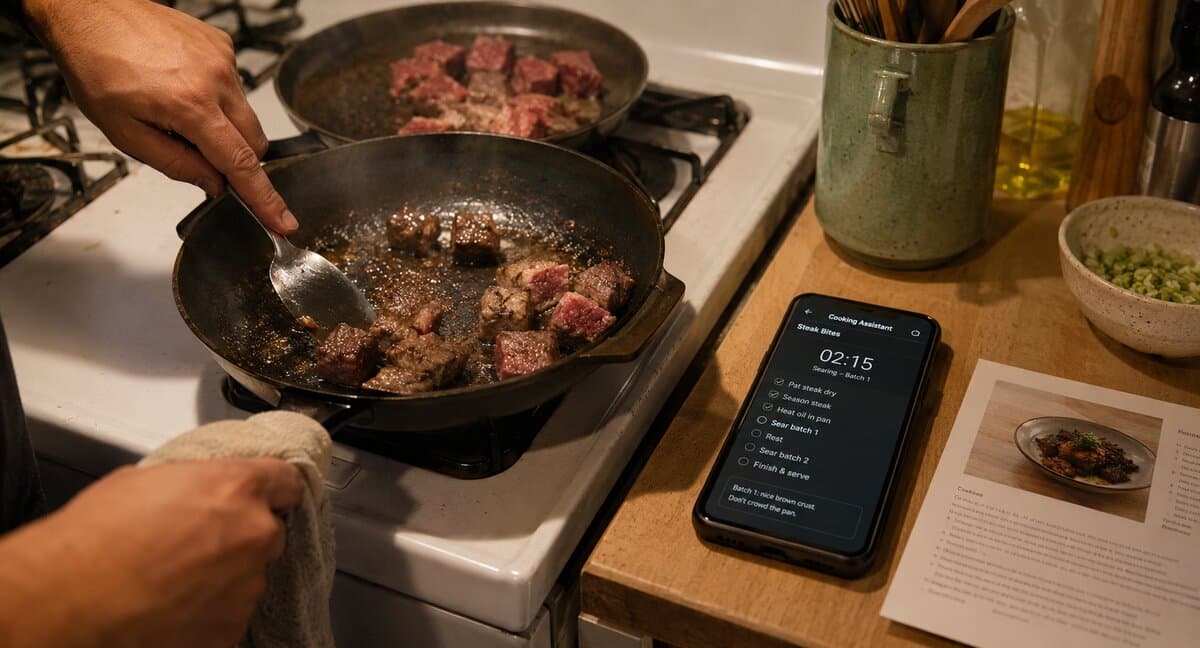
I don't film pretty food. There's a whole corner of food Instagram that's slow-motion cheese pulls and plates that look like a museum. Good for them. My whole thing is the opposite: take one technique we use on the line every night and strip it down until someone with a single electric burner and a $12 pan can actually pull it off on a Tuesday.
The Reel that changed everything for me was 40 seconds on why your stir-fry comes out soggy. Not a recipe — a diagnosis. Your home burner doesn't get hot enough, so when you dump a full pound of beef in a cold-ish pan, it steams instead of sears. The fix isn't a wok burner you don't have. It's cooking in two smaller batches and leaving the pan alone for 90 seconds. That's it. That Reel did numbers I still don't fully understand, because it named the exact thing people were doing wrong in their own kitchen and gave them a fix that cost nothing.
That's the pattern I've learned works: home cooks don't want to be impressed, they want to be un-stuck. "Why does my garlic always burn." "Why is my chicken dry every single time." "How do restaurants get that crust." You answer the real question in plain language, show it on a home stove instead of a stainless steel dream kitchen, and people trust you — because you clearly cook for a living and you're not pretending it's easy.
Here's the problem with cooking for a living, though: I'm on the line when my content peaks. I work doubles. Prep starts at 2, service runs till we're done, and the busiest comment window for a Reel is right around dinnertime — which is exactly when I'm expediting forty covers and cannot touch my phone. By the time I'm scraping the flat-top at midnight, there are 300 comments and DMs. "Recipe?" "What pan is that?" "What temp for the sear?" And I'm standing there at 1am, dead on my feet, copy-pasting the same recipe-card link to as many people as I can before I give up and go home. I wasn't ignoring people. I physically was not there when they asked.
So I set up StarLovin to hand out the thing people ask for the second they ask — while I'm still on the line. Someone comments RECIPE on the stir-fry Reel, the recipe card lands in their DMs automatically. PAN sends my cheap-gear list (the $12 carbon-steel skillet that outperforms pans four times the price). HEAT sends the one-pager on getting a real sear on a weak home burner. I'm not doing anything clever with it. It's a keyword and a card. The point isn't automation for its own sake — it's that a home cook decides to try something in the 30 seconds they're inspired, standing in their kitchen wondering what to make tonight. If the recipe shows up then, they cook it. If it shows up at 1am when I'm finally free, they've already made pasta and moved on.
There's one thing I make people trade an email for: my "Restaurant Techniques for the Home Kitchen" guide — knife grip, heat control, salting, resting, the five things that actually separate line cooks from home cooks. That one took me months to write down properly, so StarLovin collects an email in the DM before it sends, and saves the contact. Not to spam anyone. It's so that when I film the next technique in the series, I can tell the exact people who wanted the last one. That's it. No course at the end. No "master class."
I looked at the bigger tool everyone mentions — ManyChat. It's genuinely powerful. It's also built for marketing teams running real campaigns, and it bills by contacts, which climbs as your audience grows even if you're sending the same recipe card. I'm a cook who films on his one day off. StarLovin does the comment-to-DM part I actually need, keeps contacts unlimited, and caps at fifteen bucks. For me that's the whole decision.
And the stuff that isn't a link — I still answer that myself. "Can I do the sear on induction?" "I don't have cast iron, what else works?" "My family's vegetarian, what do I sub for the beef?" Those aren't recipe-card questions, those are cooking questions, and cooking questions deserve a person. StarLovin keeps those in one inbox with the context of what they originally asked for, so when I finally sit down after service I can actually have the conversation instead of digging through notifications. A card can unstick someone. Only a cook can tell them why their specific dish keeps failing.
The Reels get people to stop scrolling. But what makes someone actually cook the thing — actually stand at their stove and try the two-batch stir-fry — is whether the recipe reaches them while they still believe they can pull it off. I'm usually elbow-deep in a hotel pan of mirepoix when that happens. Doesn't matter. The card already went out.
Keep Reading

The Hard Part Was Never Making the Earrings. It Was Catching People Before the Drop Closed.
Keep reading
The Dark Corner Did Not Need More Decor. It Needed a Second Light Source.
Keep reading